Translate

Tuesday, May 20, 2014

Endless Serengeti Plains


The grasslands of Serengeti have been on my to-visit list for decades, since my high school days. The Masai Mara was also on my list, which Junior and I experienced in April 2013. And now it was Serengeti time! Serengeti, from the map and from traveler discussions, appeared many times larger, and travel had a reputation of being far rougher. The drive from Tarangire would last close to six hours, about a third of it on fairly good roads, up to the Ngorongoro Crater, and the remaining on tracks that only 4x4s can endure. 


Long drives are a good time to recharge batteries. Very few Public Campsites are equipped with charging points. Only the Simba Campsite at Ngorongoro was equipped with a bunch of charging points.


On the way, we stopped for a few seconds to pay our respects to the rich Maasai gentleman whose family is reputed to include thousands of cattle (some of which were crossing the highway), 25 wives and hundreds of children, because of which he has a school of his own. 


We crossed the lovely Ngorongoro Conservation area, skirting the famous 'Crater'. The first lookout point was completely covered with fog. It was a sea of white. We drove on, going clockwise around the Crater. A heavy blanket of fog had settled around the Crater rim. We managed to occasionally discern Massais grazing their cattle on the hillsides. 


It started to get clearer as we drove on. 


Domestic cattle grazed peacefully with Zebra and Wilderbeest right next to Maasai villages that dotted the hillsides and valleys. Further down,we noticed that Giraffes had joined the party. Sunlight starting appearing from behind cracks in the clouds, revealing plains in the distance. 


The second lookout point was fog free, but a bitterly cold wind was blowing as we peered into the crater.


More of the plains became visible. It was a feeling of expectations with patches of cloud and sunlight covering the plains far away. 


The track got rougher. Bump, bump, bump, over the dirt track. Our bone jarring journey to the Serengeti began. This was going to be our life for the next few days. This was what we were waiting for. This experience is also known as the 'African Massage'.  


After a little over an hour, we were welcomed into the Serengeti National Park!


The track across much of the route was very straight and very dusty. Looking back from the arch of Serengeti Park, we could see the mountains of the Ngorongoro area in the distance.  


The kopje at Naabi Hill, almost 20 km from the welcome arch, is the point where you pay the fees and get a good glimpse of what is ahead. The plains stretched on and on. We were reminded of the landscapes we had experienced in the Mara a year ago. It felt really good to be back! 


May the game drives begin! More often than not, our 4x4 left a long trail of dust behind us.


This post is a small collection of views of landscapes, trees, birds and 'non-big-cat' wildlife that we spotted in Central Serengeti over 4D/3N.    


Zebras rest their chins on each other and keep a watch for predators. Teamwork!


A large Secretary Bird perched on top of a tree.


For the perspective, this is where we spotted the Secretary Bird.  


Vast plains and with an occasional tree are a very common sight, almost seem to represent the Serengeti. The trees must be getting lonely, I thought. 


Is that an African Fish Eagle? In the plains of Central Serengeti? I was under the impression that these eagles live near large bodies of water.


A Marabou Stork up a tree. That was the first time I have seen this giant bird up a tree. Had no idea they could fly high!


Up until then I had seen Marabou Storks on the ground. I understand they are scavengers. 


Landscapes that you can gaze at, all day. This is an evening view. 


A Saddle-billed Stork surveys the grasslands.


It's not easy identifying a bird that is staring straight at you! A Northern White-crowned Shrike.


An Acacia tree with birds.


Blacksmith Lapwing Plover. Many of the bird species have been identified via 'crowd-sourcing' from experts in the TripAdvisor forum. I was too busy admiring the views and forgot to take notes.


Eastern Chanting Goshawk. Atop a kopje.


A Chestnut-bellied Sandgrouse.


Not too far away, a Yellow-throated Sandgrouse. Sort of similar looking.


Ahhhhh, those landscapes again! Junior adds to his Plains, Sun and Cloud collection. 


A large group of Hippos in the evening, noisily snorting and splashing away.


A Black-backed Jackal looks suspiciously at us. One of the smaller carnivores. 


Black-backed Jackals appear to be quite active earlier in the day.


A Black-backed jackal runs away with the head of a rabbit early in the morning.


A spotted Hyena crosses the track. We came across several groups, laughing away eerily in the grass. 


Part of the Plains, Sun, Cloud and Rain collection. 


Hello, down there! 


This picture is from the Plains and Solitary Tree collection.


Worried Hartebeest make sure we are not invading their territory, beyond a point. 


A Monitor Lizard basks in the early morning light.


While an Agama Lizard gets a tan.


Another one from the Plains collection, as the sun prepares to go down, and we prepare to race back to the Campsite. 


Well, this was a quick look at the plains and some of the wildlife of Central Serengeti. I think it would be right to say that we traveled to admire and experience the landscapes, the atmosphere and wildlife, the sunrise and sunset, to just be there, to camp out in Public Campsites and take it a moment at a time. Pause to admire the large predatory birds perched high up on Acacia trees during sunset. At least a couple of Marabou Storks there.


We did not have any specific expectations about wildlife sightings. It was as if being there was wonderful enough, we felt blessed to be among the privileged few who get an opportunity to experience the magic of being a mere speck wandering around in the 'Endless Plains'... leaving a momentary dust trail behind. 


Enduring memories... the vast, seemingly endless plains of the Serengeti. 


-=-=-=-=


Please click below for posts in this series:


Namanga Border Crossing


The Gentle Giants of Tarangire

Tarangire revisited

Endless Serengeti Plains

Migrating herds, Crocodiles and Vultures at Kirawira

Big Cats of Central Serengeti

Camping under African skies


Flamingos at Empakai Crater Lake

Ngorongoro Crater - Wildlife, Maasais and Flowers

Campsite food and Nyama Choma in Mto Wa Mbu

From green to gray, the stark beauty of Lake Natron


Videos - Tarangire, Central Serengeti


Videos - Central Serengeti, Western Serengeti, Ngorongoro, Lake Natron

Two nights in Arusha


-=-=-=-=


Monday, May 19, 2014

Tarangire revisited


Big cats and other inhabitants

We were in Tarangire, a renowned Ellie Park. We sighted Ellies again all over the park the next day, as well. This post is for the relatively smaller animals, as well as birds. One of our early sightings was a family of four Cheetahs behind and perched up an anthill, surveying the surroundings.


They decided to clamber down soon, cross the road and head to another anthill a greater distance away on the other side.


The sighting of a Lioness that appeared snug up a tree was likely a rare sight. We  were there a long time, and the Lioness appeared most content to stay up there. An interesting drama was being played out below. A Baby Ellie got scent of the Lioness and kept frantically running around in circles, trumpeting away, unable to figure out where the Lion scent was coming from.


Another Lion sighting was that of a pride of about four adults and two cubs who were busy devouring two Warthog carcasses. The sounds they were making were clearly audible, loud snorts and groans. The grass was slightly tall, so we could not get a clear view. I have a video that I will snip and upload soon in a separate post for videos.


Our big cat sighting in Tarangire can be summarized as follows:


Three Lion sightings, all different. First, a solitary Lioness perched up in a tree with the baby Ellie going crazy running around in circles, trumpeting, right under the tree. Second, a pride of about six adults and cubs busy devouring two Warthog carcasses, making horrific snorting and cracking noises. Very loud noises, emanating from the grass. Our third Lion sighting was a glorious sight in the slanting warm rays of the sun, a Lion basking in a sea of green grass in a royal pose, slightly far away.  


Tarangire also showed us one Cheetah sighting split across the road with a total of about six cats. 


One Leopard sighting, it was all over in a flash. Amos sighted a Leopard up a tree, but as we approached, the cat jumped down, hid in the grass with the head visible, then quietly bounded away gracefully in a flash. What an impressive sight that was, too quick for us to aim and shoot! 


Now that we have glimpsed Ellies, Giraffes, a few Bovids, Cheetahs and Lions, time for a few feathered friends. Several birds were unidentified, due to not taking notes (I was too busy admiring the views!) and due to a poor memory. Thanks to our Birder friends for helping identify the birds without names. 

Yellow Necked Spurfowl.


White Browed Coucal.


Bataleur by the river.


Southern Ground Hornbill.


Lilac Breasted Roller.


Woodland Kingfisher.


Barefaced Go-Away Bird (a Turaco).


Helmeted Guineafowl.


Von der Decken's Hornbill. 


A green-coloured Chameloen crosses the track, belonging to the Flap-necked species. Not much chance of a camouflage here!


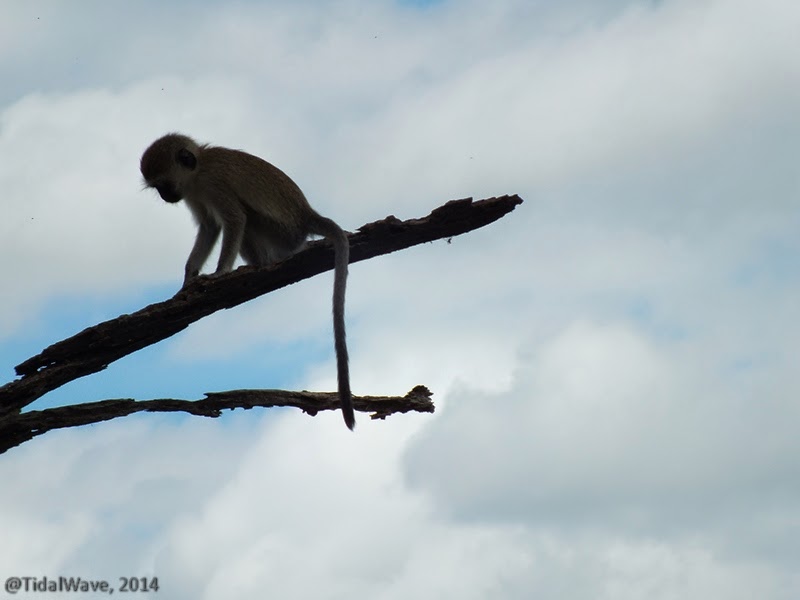
Vervet Monkey.


African Hoopoe.


Favourite position during Game drives, useful to absorb the sights, catch the little creatures along the way, and grab a few shaky pictures and videos. Can't ask the driver to stop at each corner, can you?


Sights like the grand old Baobab trees.


We took a trip far down South to the Silale Swamp area. It was quiet, ours was the only vehicle for kilometres around.


White-headed Buffalo Weaver.


Superb Starling.


Lunch time at Silale Swamp. Moses packed picnic boxes for us everyday since we would typically be out from dawn to dusk.


Hundreds of Buffalo in the distance.


A large herd stops for a minute to take a closer look at us.


Elephants walk by in single file along the swampy areas.


The Silale Swamp area was wonderfully remote, wild and quiet. It was just us. Well, that's what we thought.


A bunch of Open Billed Stork (African Openbill) looked on. But they were not the only creatures around. We would find out shortly. In a slightly painful manner! 


Hordes of Tse-Tse Flies took a liking to us, in a small way to Amos and me, but in a significantly larger way to Junior. Poor fellow, he got pestered and bitten for over an hour as we sped back to safer havens towards the northern part of the park. A short spell of rain helped ease the situation. The hordes of Flies stopped chasing us. The photo of a Fly in the 4x4 is in memory of our Tse-Tse Fly encounter.


Junior is relaxed once again, and resumes his usual photography business, with the Park bathed in the warm light of the afternoon sun.


It's time to head back to camp once again as the sun prepares to retire.


Common Ostrich seem quite relaxed. The last Lion sighting we had encountered was about half an hour ago, quite far to photograph.


The rays of the setting sun catch a large group of Common Ostrich as the birds strut around.


A troop of Baboons appear to be on their way home, as well.


Acacia trees lit up golden during sunset.


Early morning black coffee in the small public campsite was a wonderful feeling, with the cool air and skies gently lighting up.


A Verreaux's Eagle Owl keeps watch as we head out for our 6 AM game drive, while it is still semi-dark. Also known as the GIant Eagle Owl or Milky Eagle Owl, it is Africa's largest and the world's third heaviest owl. 


The small public campsite we stayed in was right inside Tarangire Park. The first camp, Roika Tented Camp, was situated outside the Park, separated by the Tarangire River with ankle deep water. So, we could have strolled across the river into the Park! We had in fact seen Ellies, Impalas and Gazelles in the area surrounding the Camp the previous evening. Good reason to have a team of Maasai people escort us as we walked from our cooking and eating area back to the room. More on this in another post....


Maasai villages dot the areas near the park. Adults and children escort their cattle as they graze around the Park. Little children often stand and wave, perhaps hoping for small goodies from visitors passing by.


Life goes on in the Maasai villages just outside the Park. We noticed a School and a Church.


Several typical homes. Only a road separates the Park from the Villages in the area.


Over the duration of our travel in Tanzania, I would realize with a sense of shock and awe about the relationship between the Maasai people, the wildlife and the environment. They form a strong ecosystem. The Maasais and the wildlife respect each other. There appears to be a magical bond and understanding between them. The Maasai people and wildlife live very close to each other, understand each each, respect each other and coexist.  I guess this has been the way of life for generations. Learning this was one of the greatest 'A-ha' moments of my Tanzania experience..!! 


-=-=-=-=


Please click below for posts in this series:


Namanga Border Crossing

The Gentle Giants of Tarangire

Tarangire revisited

Endless Serengeti Plains

Migrating herds, Crocodiles and Vultures at Kirawira

Big Cats of Central Serengeti

Camping under African skies


Flamingos at Empakai Crater Lake

Ngorongoro Crater - Wildlife, Maasais and Flowers

Campsite food and Nyama Choma in Mto Wa Mbu

From green to gray, the stark beauty of Lake Natron


Videos - Tarangire, Central Serengeti


Videos - Central Serengeti, Western Serengeti, Ngorongoro, Lake Natron

Two nights in Arusha


-=-=-=-=