Translate

Monday, April 15, 2013

Sights, Signs and Thoughts along the way

You don't get to live on the Equator or zig-zag around the Equator while living in Asia, unless you happen to find yourself in Indonesia or perhaps in the atolls of Kiribati. That meant a few photo opportunities while we were in Kenya.


While most of the roads connecting the most visited parks were in good shape, a small stretch in the Aberdares area was being repaired. We followed a truck full of workers for a while.


Wou get a demonstration of the 'Coriolis Effect' at one of the Equator spots. A bowl of swirling water was set up 20 metres from the Equator mark, and the match stick appeared to rotate clockwise North of the line. Now, with the diameter of the Earth being about 12,700 km, I wonder whether 20 metres would make an impact. Anyway... say cheese, click!


The match stick appeared to swirl counter-clockwise 20 metres south of the line . Is 20 metres adequate? True or trick? Click!


No swirling when the bowl was set up along the line that said Equator. Hmmm....


We were on holiday, so enjoyed the demonstration and the photo opportunities. We also survived the efforts of the souvenir sales person to sell us things at highly inflated prices. Exactly the same things (all identical, factory made) were available at a roadside store at the Rift Valley lookout point for about 1/20 (one-twentieth) the price quoted at the store along the Equator. Maybe it's the result of the 'Equatorial effect'?


The Rift Valley is an interesting trench formation that runs a very long way, a result of the movement of tectonic plates many millions of years ago.


We would be getting into the Valley, to the Lakes, and then out again.


Advise to visitors at the look out point.


We passed many areas with Tea and Coffee plantations. I thoroughly enjoyed Kenyan Tea and Coffee during our week there. I guess 6,000 feet must be an optimal altitude for growing Tea and Coffee, like it is in the mountains in the Southern and Eastern parts of India. The Kenyan highlands, however, is a huge area that stretches over hundreds of sq km. Remarkable, naturally air-conditioned weather!


Thompson Falls was a nice stop, with impressive views of the gushing water, fed by the monsoon rains. What was not much fun was people dressed in Kikuyu Tribe costumes offering to take photographs with us for a fee. Reminded me of the Native Indian reservation tourist spots in North America. We also got a few offers of getting photographed with Iguanas. No clicks here!


I wondered whether I would get a chance to ride a motor-bike taxi, found commonly at villages along the highway. Good to see them. The only motor-bike taxis I seem to find these days are in Bangkok and Goa.


We climbed down into the Rift valley on the way to the Mara. The roads in this part of Kenya are excellent! However, a few sections of the road around the Aberdares and near Narok had been affected by landslides and rains, so we needed to take very short detours. Not show stoppers!


I wondered when I would get an opportunity to ride a Matutu like this one, speeding along the floor of the Rift Valley to the next village.


We drove along the floor of the Valley for a long while, with mountain sides rising around us, partially hidden by clouds.


It is interesting that the Lakes are situated on the floor of the Rift Valley. Lake Nakuru sits high up, indeed!


Signs like these are common by Kenyan highways. Fried chicken and meat ready..!! This one is in Narok, where we filled up the fuel tank. I wanted to step in there, but James refused.


Butchery and Pub signs are commonly found along the highways.


Agro-vet supplies, little hotels, mobile recharging and general purpose stores are equally common.


We even located the local ManU Fan Club, much to Junior's delight.


The dirt road welcomed us to the Mara shortly after Narok. Thereafter it is bump-bump-bump all the way. Certainly adds to the charm. How boring, insipid and lifeless it would be if the roads were to be tarred!


Our drive back to Narok was early in the morning. We left Mara Serena at 6 AM.  The rangers would not allow us to leave earlier.


Masai farmers were going about their daily work at that time.


Here is a quick look at the drive while heading back from the Mara Triangle to Narok and then to Nairobi.


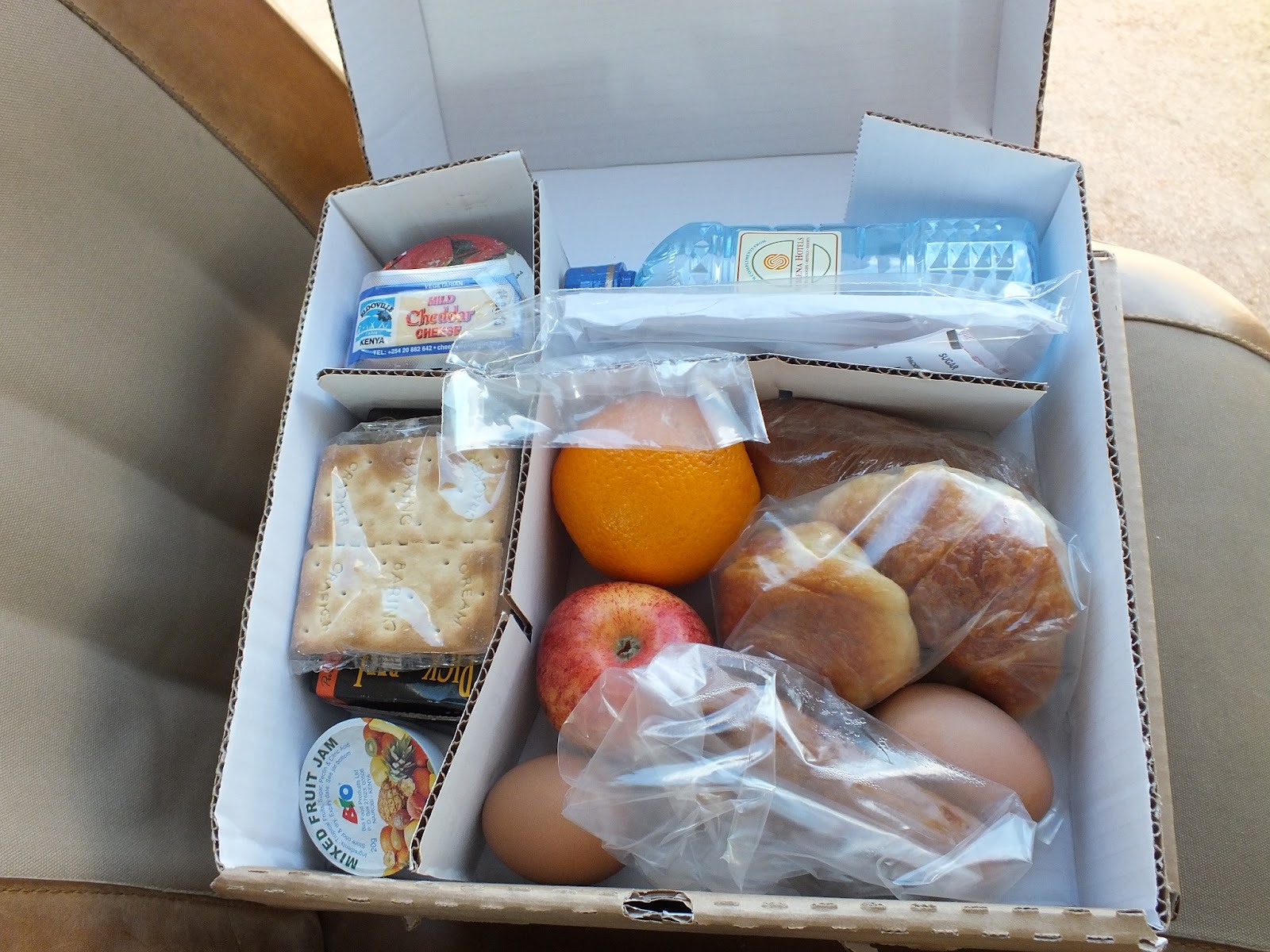
The Mara Serena folks had packed three breakfast boxes for us earlier in the morning.

We stopped at the rest stop near Narok on the drive back to Nairobi.


It was a good opportunity for a few photographs with James and the sturdy Nissan van.


Wheat is also grown around the Narok area. We passed kilometres of green fields.


The geography and sights of the Rift Valley had become very familiar to us by now, having criss-crossed the area over the week. We glanced back at the Rift Valley for the  last time on the drive back to Nairobi.


In Nairobi, we said Hello to the Giraffes and fed them little food pellets.


Giraffes have long, sand paper like purple tongues and their saliva is reported to have antiseptic properties.


Our last stop was at the well known Carnivore Restaurant near Wilson Airport.
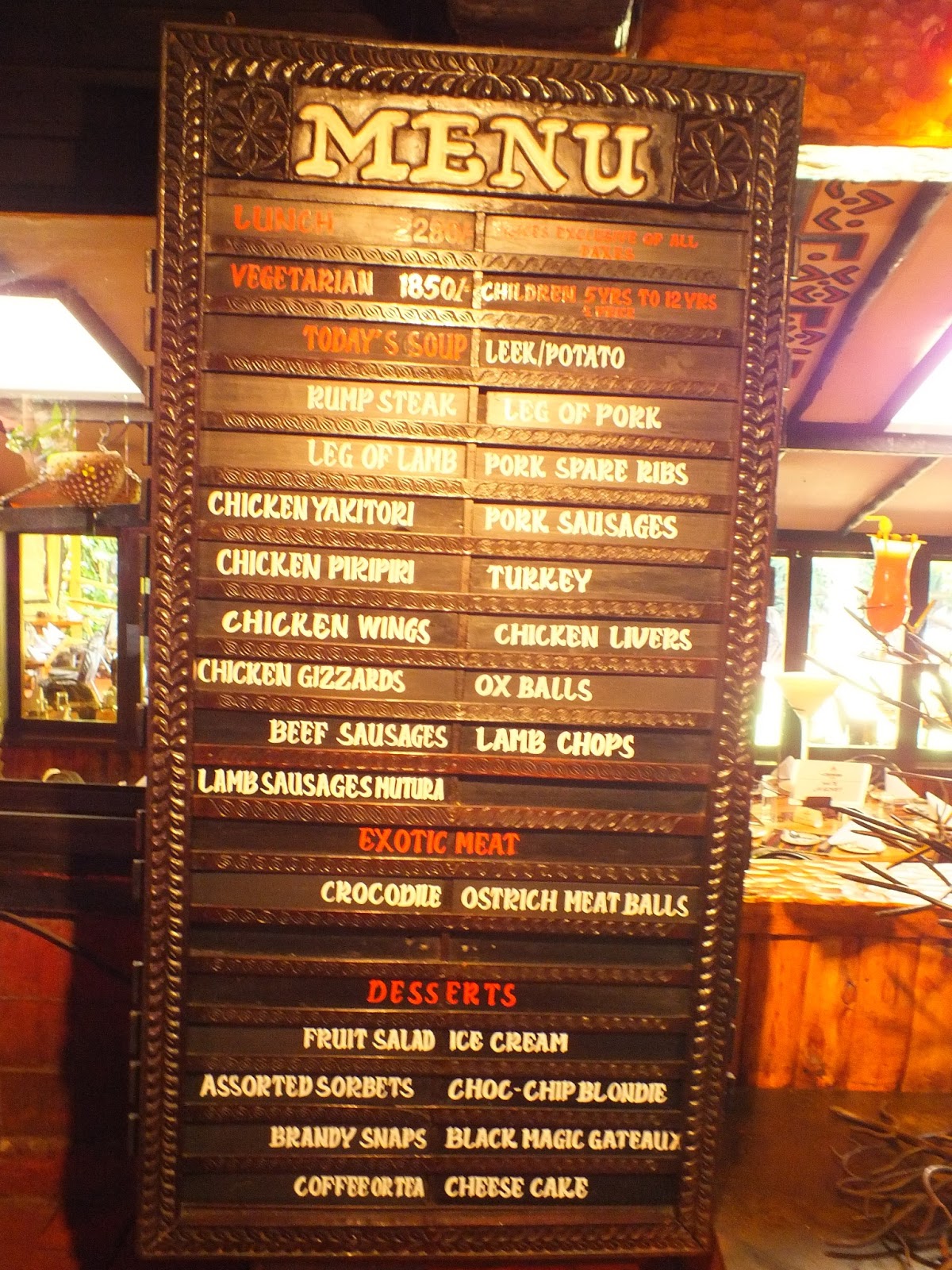


The large grills are in front, right at the entrance. 


Part of the menu...


James dropped us back at the airport well in time for check-in, passport and Yellow Fever certificate checking processes. It was an absolutely amazing and unique trip, beyond words. We learnt and experienced an incredible amount about the Highlands, Valley, Wildlife and terrific Landscapes, thanks to James, our driver-guide-teacher for the week. We expressed our grateful thanks to James (and the Travel HTT team) as we said Goodbye.


We wished James and his family well, while he wished us a safe trip back.

If you have reached this far, thank you for joining us on our journey across Kenya. Until next time, then..!!


Please click on the links below to follow us around our Kenya experience:


-=-=-=-= The End


Maasai Mara, Kenya

Ever since I was in the 8th grade, one of my dreams was to visit the Masai Mara. While sitting in Geography class, with the teacher droning on about the grasslands of the world, I would already be far away in the Mara. My dream finally came true.

I am now convinced that no amount of reading and staring at photographs of the Mara can prepare anyone for the visual impact of the Mara experience. The grasslands roll on, and on and on as far as one can see, punctuated with acacia trees, shrubs, grazing animals and shadows of clouds.


Sunsets are glorious, golden moments that you wish would stretch on and on.  


'Off season' is such a wonderful time. The animals are probably not as wary of the rain as tourists are, and even if they are, they may not be able to run too far. The monsoon clouds that tend to move around would catch up soon enough and provide the animals with a short shower at no charge. It may be hard to believe this, but during our 3D/2N stay in the Mara, we may have sighted a total of about 5 or 6 tourist vans and 4*4s in all. Add to that one jeep belonging to a Hyena research project, usually stationed a couple of hundred metres from our Lodge where there was a hyena den with at least 8 to 10 baby hyenas and several adults. 


The Mara in April was kilometres and kilometres of nobody else, plains, sun, clouds, shadows of clouds on the plains, lots of animals and us. Once again, a very, very private safari!

Well, there's not much more that I can say, or am able to say. 


Please click on the links below to follow us around our Kenya experience:


-=-=-=-= The End


Saturday, April 13, 2013

Lake Naivasha, Kenya

Naivasha was a pit-stop between Nakuru and Mara. Naivasha town appeared to be quite neat. We paid the equivalent of USD 70 each at the office by the Lake, for the boat ride and trip to Crescent Island. The weather was grey, with a steady, freezing drizzle. We wore a half-jacket, a full-sleeve jacket and a life jacket on top of that. Joseph was our guide, a knowledgeable man.


We were welcomed by scores of Cormorants perched up on trees near the dock area.


Hidden away towards the shore were several huge hippos at several spots around the lake. These were the only slightly disconcerting sights of the morning.


Away we went chugging around the lake in the freezing drizzle, admiring the many birds, and then on to Crescent Island.


Please click here for Glimpses of Lake Naivasha.......


Please click on the links below to follow us around our Kenya experience:


-=-=-=-= The End

Lake Nakuru, Kenya

The association of 'Pink Flamingos' with Lake Nakuru seems to overshadow the other attributes of the Lake and Park. The first question in my mind was 'Will the millions of Flamingos be around?'. Our final decision was, let the Flamingos be, we will take it as it comes, and we will enjoy the Park for all else that it has to offer.

Breakfast was at the time of 6:30 AM, we were the only ones in the hall. departure from Ol Pejeta was at 7:00 AM, we passed through the Aberdare area, mainly good roads with a rough patch in between, and reached Nakuru by 1 PM, stopping a couple of times along the way, once at a spot along the Equator, and once at the spot where we hit the Rift Valley (described in another post).

Our room at Sarova Lion Hill Lodge was the last one before the suite, which was the last room, and which we we were not entitled to, being non-suite people. Room #22 provided us a terrific view of the Lake through the trees. The afternoon was sunny, yet cloudy. The result was a magical, shimmering effect. It appeared as if we were floating above the clouds. Maybe we were. Maybe my eyes were playing tricks!

The layout below is: Room #21, Room #22 (our room), Suite, Garden, Shimmering lake, Heaven.


Our game drive began at 2:30 PM after a buffet lunch with a bunch of Conference groups. Once again, we did not pass any tourist vehicles during our drive, only Rangers' jeeps, as we went around the Lake slowly, taking about 4 hours to do so.


Our one Lion and two Lioness sighting was amazing. James, our driver, said that he noticed the flick of a 'tail' over 100 metres away. This happened while he was driving. Another realization of the value of a competent driver-guide. The lions were lying among the rocks and grass most of the time, and occasionally stirred. The photo below was taken using our new 30X bridge Fuji camera. Not of Nat Geo standard, but will do quite well for us.


Lake Nakuru was an interesting experience, with a large variety of birds and animals. The grey afternoon and cool air added to the feeling of uniqueness.


The 'millions' of Flamingos were missing. Maybe a few hundred or thousand were present. However, we sighted many Rhinos, Giraffes, and a range of creatures including the littlest Antelope, the Dik-dik, as well as Cormorants, Pelicans, Storks, Egrets and other colourful birds.

Please click here for Glimpses of Lake Nakuru.......


Please click on the links below to follow us around our Kenya experience:


-=-=-=-= The End


Friday, April 12, 2013

Ol Pejeta Conservancy, Kenya

About 4 hours from Nairobi, after a tea-coffee-rest-room break, a short dirt track off the highway led us to the Ol Pejeta Conservancy.


We were welcomed by smiling guards and chirping Weaver Birds that had built nests around the Solar panels. Our first bird sighting!


It was an opportunity to stretch while James sorted out the payments and receipts. Wow, what are we in for? The gates are the only areas inside the park where we can get off the vehicle. Do the famed Kenyan plains look like this? Someone should have told me, wait till you get to the Mara!


A brightly striped Zebra welcome committee greeted us barely a couple of hundred metres from the gate, including one Zebra with a strangely shaped, humped back. Our first animal sighting!


Sweetwaters Tented Camp turned out to be a wonderful, calm experience. I had requested for Tents #1 to #7, based on traveller feedback. We were allotted Tent #3. Right opposite us was the 'in-house' watering hole, where you can gaze at a constant flow of deer, antelopes, zebras and birds all day, and night.


The zebras appear extremely peaceful at night, as well. The tripod we had packed in our strolley came in handy for long, night exposures. The zebras stand still long enough. Junior's enthusiasm was infectious, it was unbridled joy for both of us.


Being 'off season', the occupancy was perhaps between 5 to 10 tents. A handful of tables would be occupied during lunch and dinner, while we used to be the only ones at breakfast at 6:30 AM, before our early morning game drives. Early to bed and early to rise.  No time to lose. Wake up early, watch sunrise over the watering hole across the electric fence and over Mount Kenya in the distance. Ah, what a life!


During game drives, it was just the two of us in the van, along with our teacher James. Not just that, we felt like we had the entire Conservancy to ourselves. A very, very private Safari!

Enough said. Please click on the link below for a glimpse of the Ol Pejeta area.

In summary, Ol Pejeta Conservancy and the Serena Sweetwaters Tented Camp turned out to be a wonderful introduction to the Kenyan safari world.

Please click here for Glimpses of Ol Pejeta Conservancy........


Here is a pleasant evening scene at the Lodge, inside the electric fence.


Here's a Video summary of the Ol Pejeta leg of our safari: 
2013-04 - ol Pejeta Conservancy, Kenya Slideshow 

Please click on the links below to follow us around our Kenya experience:


-=-=-=-= The End